Gravity Exploration Institute
Watch a video showing the first detection of gravitational waves
Our research focuses on detecting cosmic gravitational waves and developing gravitational-wave observations as an astronomical tool.
We are part of the Laser Interferometer Gravitational Wave Observatory (LIGO) scientific collaboration which announced the first direct detection of gravitational waves in 2015, a century after they were first predicted by Einstein.
The LIGO group is made up of more than 1000 scientists worldwide who have joined together in the search for gravitational waves. It is involved in the space-based eLISA mission, and is working on the design study of the 3rd generation Einstein gravitational-wave Telescope (ET).
As part of the LIGO scientific collaboration, we are searching for gravitational waves from inspiralling and merging binary neutron stars and black holes, stellar collapse and supernovae, glitching and flaring neutron stars, gamma-ray burst sources, and unknown or unexpected sources.
We model astronomical sources of gravitational waves, in particular the strong field dynamics of binary black holes.
Creating astronomical tools
We are working on how to extract astrophysical and cosmological information from observed signals leading the science case in support of the Einstein Telescope - a future underground detector with ten times better amplitude sensitivity than advanced detectors.
We also co-founded the British-German GEO 600 detector, and are currently co-authoring the white paper submitted to ESA on the space-based eLISA mission.
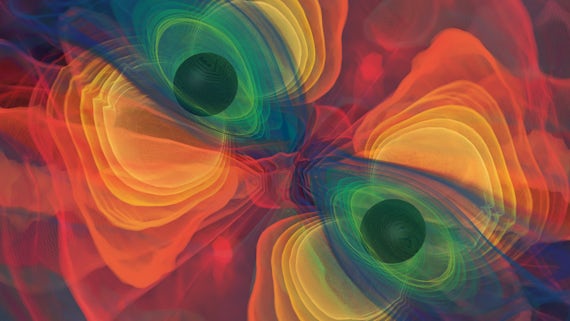
LIGO scientists detect gravitational wave signal from the merging of two black holes.